 Chernivtsi region,
  +38 (050) 50 50 103
 Mon.-Fri.: 08:00-20:00,
Services
- Category: Endoprosthesis
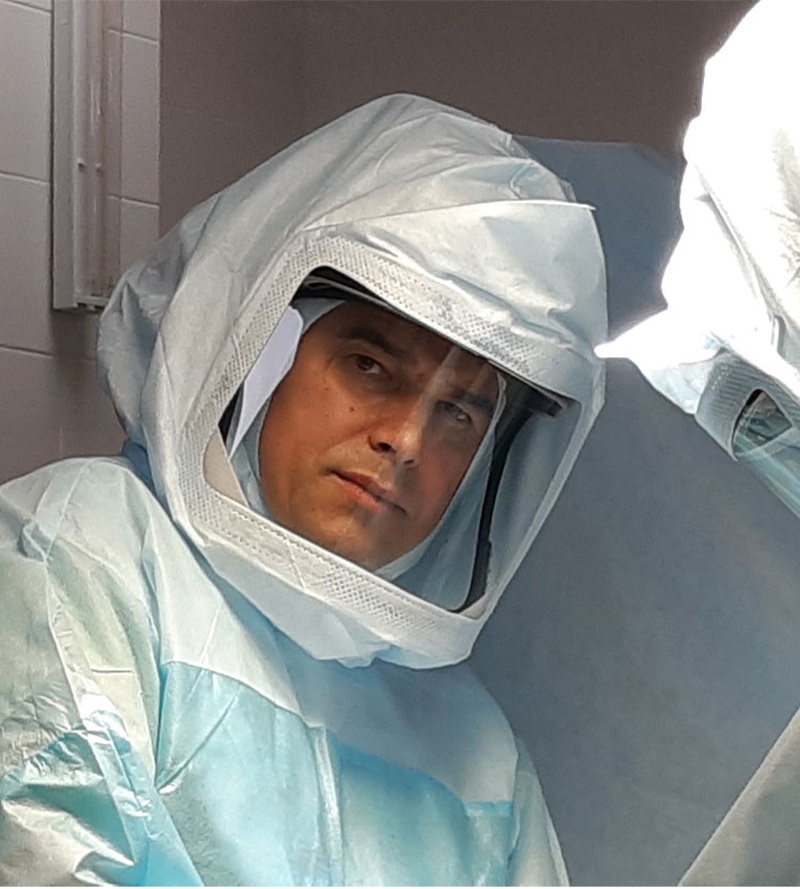
Revision replacement of hip and knee joints
Joint replacement is a surgical procedure that involves the replacement of a damaged joint by an artificial one that fully replicates the shape and function of a biological human joint. The implantation of the artificial joint allows the patient to live a more active lifestyle than before without any feelings of pain and discomfort.
Joint replacement is one of the most successful procedures in treating various different health conditions, with the artificial implant being able to last for around 20-25 years. Unfortunately, the rapid increase in the number of primary hip and knee joint surgeries worldwide has led to an increase in various complications. These complications require a revision replacement, which is essentially a second surgical procedure that involves the removal of the original implant and a replacement of a new one. Such complications are relatively rare.
The most common causes of revision arthroplasty are:
- Repeated (recurrent) dislocation of the implant;
- Implant wears off or loosens;
- Periprosthetic infection.
1) Implant wearing off or loosening
The modern implant is made out of high strength, bionert metal with polymer parts and sometimes ceramics. Micro particles of plastic or metal of the hip or knee implant tend to wear off with active use. Younger, more physically active patients tend to have a higher risk of their implants to loosen up and wear off. Older patients therefore do not require repeated revision surgery. Middle-aged and young patients will almost inevitably require revision joint replacement, as the constant repetitive motion of the mechanical structures will result in the small parts of the implant to wear out. The likelihood of this happeneing depends on the lifestyle and type of implant that was used in the initial joint replacement surgery. Some micro particles can be made of polyethylene, some might contain cement, ceramics or metal. When these particles are released from the implant, the patient’s immune system recognizes them as foreign matter (not natural to the body). As a result, the body will generate an immune response, leading to the destruction of the bones around the implant (a condition called osteolysis). If the bone fracture is severe enough, the components of the hip or knee joint may become loose, resulting in bone fracture. Mechanical wear that causes the implant to wear out is one of the most common forms of mechanical failure. However, other forms of mechanical failure, such as prosthetic failure, may occur during an injury.
2) Periprosthetic infection
Periprosthetic infection can occur at any time after surgery. The risk is at its highest during the first six weeks. The risk of "late" infections after this period is lower. Occasionally, a non-related infection can occur in the mouth, gums or teeth. Other infections may occur in lungs, urine and skin, resulting in the bacteria to enter the bloodstream. The bacteria can infect the implant, causing joint pain and fever. The treatment of periprosthetic infection is complex, expensive, and requires more time in the operating room compared to a classic revision surgery in the absence of infection, consequently putting it a higher failure risk. To avoid any infections, it is very important for the patient to closely follow all the recommendations of the doctor after the surgery. In case the infection occurs, the surgeon will attempt to identify the type of bacteria responsible for the infection. This is conducted by taking a fluid puncture from the hip or knee implant and sending it to the laboratory for it to get tested. Once the type of bacteria is identified, the appropriate antibiotics are administrated to the patient to fight against the infection. The treatment depends on the type of bacteria and its sensitivity to antibiotics, as well as the severity and duration of the infection. It mainly involves a combination of surgery and a course of antibiotics, but the surgeon will make sure to discuss all possible harms and benefits of each treatment option.
The most common treatment options are:
- Thorough a secondary surgical cleaning of the joint implant. This is usually done at the early stages of infection (within a few days or weeks). This is usually recommended when the infection is detected very early (within a few days or weeks). Patients need six weeks of intravenous antibiotics and often a low dose of oral antibiotics over a long period of time.
- Two-stage revision arthroplasty: in the first stage, removal of all components of the implant and cement takes place. This is surgically performed, with the opening and flushing of all cavities as well as the installment of a temporary cement spacer with antibiotics. In addition, systemic antibiotic therapy is carried out within 6-8 weeks of the first stages of surgical treatment. The second stage consists of the removal of the spacer and re-implantation of the final revision endoprosthesis (usually 1.5 to 3 months after initial surgery in the absence of clinical infection).
3) Repeated (recurrent) dislocation of the implant
Dislocation of the implant is also considered to be one of the complications that need to be taken into account, as it leads to repeated, often difficult, surgical interventions. Dislocation of the implant is a problem for both, the patient and the surgeon, as it is associated with intense pain and significant impairment of function. The dislocation mainly occurs due to the misalignment of the pelvic and femoral components of the implant.
| Doctor | Name | Speciality | Work time (Sunday) |
|---|---|---|---|
 |
Процюк Віктор Васильович | Traumatology and orthopedics | - |
 |
Васильчишин Ярослав Миколайович | Orthopedist-traumatologist | None - None |
- Category: Endoprosthesis
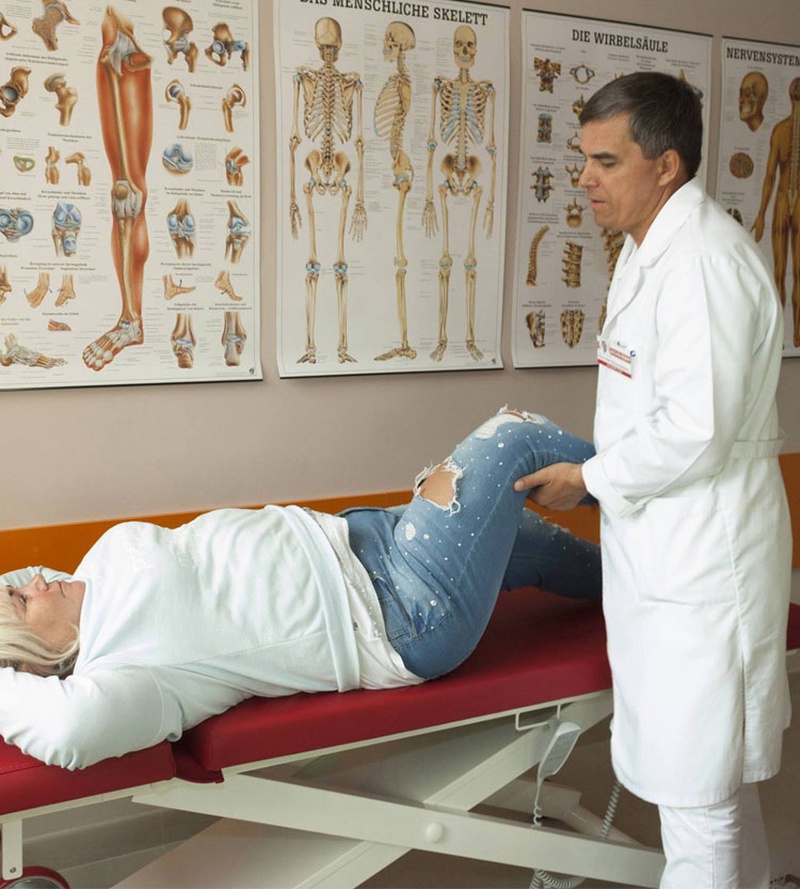
Knee joint replacement is a surgical replacement of the knee joint with an artificial joint, which fully replicates the anatomical elements of the human knee joint. This replacement allows the patient to perform all the essential movements without any feelings of pain or discomfort. Implantation of the artificial knee joint does not require a large bone resection, as the knee joints are preserved during the surgery. Some cases will require the ligament repair if they have been previously damaged.
How to know if you need a knee replacement surgery?
Knee joint replacement is performed when medication does not help with improving the overall knee condition. It is required when the medication does not improve pain relief even with the help of pain killers, as well as if there is a strong restriction in movement. These signs identify a damage in articular surfaces, meaning that you might need knee joint replacement, which aims to bring back a mobile and painless joint that will allow you to return to your usual lifestyle.
Before going into surgery, a consultation with a professional orthopedic surgeon is required. The doctor will determine the indications and contraindications for the joint replacement, by performing the necessary research and selection of the appropriate implants. X-ray examination will determine the condition of your joint and allow the doctor to make the exact and necessary measurements. You will be aware about all the possible risks and complications of the surgery.
The aims of the replacement:
- disappearance of pain
- restoration of limb function
- restoration of the normal axis of the limb
- restoration of full amplitude of movements
- restoration of joint stability.
What are the indications for knee replacement?
Indications for knee replacement:
- gonarthrosis with pronounced functional disorders, pain syndrome and malformed (valgus or viral) limb installation
- aseptic necrosis of the femur
- rheumatoid polyarthritis
- Bekhterev's disease
- consequences of trauma and osteosynthesis of the distal end of the thigh and the proximal end of the tibia (not earlier than 3 months after removal of metal structures)
Are there any contraindications for knee replacement?
Contraindications for knee replacement:
- active infectious process
- diseases of the cardiovascular and bronchial-pulmonary system in the stage of decompensation
- the presence of foci of purulent infection in the body (tonsillitis, carious teeth, chronic
- sinusitis and otitis, purulent skin diseases, etc.)
- lack of active extension in the knee joint
- acute myocardial infarction and acute cerebral circulation within 1 year.
- primary arthrodesis
- acute thrombophlebitis
- 3-4 degrees of obesity
- general somatic and mental illness in the acute stage.
What are the types of knee joint replacement?
There are several classifications of knee replacement: they are divided into fixed and movable by the type of plastic liner used.
By the number of replaced articulated surfaces - single-click, bipolar and tripolar. According to another classification, the knee joints are separated.They are:
- unbound (low-congruent, non-stop device with posterior cruciate ligament retention)
- semi-coupled (there is anteroposterior stabilization with replacement of the posterior cruciate ligament)
- associated (with limited varus or valgus deviation and have rotation in the plane of bending)
- hinges (having a rigid or rotary hinge with the possibility of moving in one plane)
Cement fixation of all components of the replacement is the "golden standard" of knee replacement. Cement-free fixation of components is possible, but less reliable than cement, and the cost of such implants is usually higher.
At the present stage, the requirements for knee joint replacement have increased significantly. They must:
- replace the affected joint structures
- keep intact joint structures
- restore the physiological volume of movements
- have a modular structure to solve various problems in the knee joint
- optimize the axes of limb loading
- be installed with simple operating techniques
- have high mechanical resistance to wear
- provide easy replacement of components.
The basis of any (biomechanical) classification of knee joint replacement is the degree of limitation of mobility in the sagittal and frontal plane, as well as the degree of connectivity of the femoral and tibial components.
How to determine which joint is best for me?
In each case there is an individual approach of implant selection for the patient.
What happens during the surgery?
Before the surgery, the patient undergoes a complete clinical examination (analysis, expert advice, anesthesiologist examination). Hospitalization of the patient takes place 1-2 days before surgery.
Surgery. In standard cases, the implantation of the artificial knee joint takes up to 1 hour. During the procedure, different measures are taken to prevent infectious complications. The first bandaging is done 24 hours after surgery. In the next period, once every 2-3 days. The removal of the sutures is usually 3 weeks after surgery.
Post-operative rehabilitation
Rehabilitation classes take place on the second day after surgery, which involve the presence of an exercise physician. The movements are active and passive, where the patient can start walking while being supported by a crutch. On the next day, the patient can start walking with cane support. After all the post-surgical procedure requirements, the patient can be sent to a rehabilitation center.
| Doctor | Name | Speciality | Work time (Sunday) |
|---|---|---|---|
 |
Окрім Ілля Ілліч | Traumatology and Orthopedics | - |
 |
Васюк Сергій Володимирович | Orthopedist-Traumatologist | - |
|
Васильчишин Ярослав Миколайович | Orthopedist-traumatologist | None - None |
- Category: Vertebrology
- Category: Vertebrology
- Category: Treatment of injuries
- Category: Vertebrology
- Category: Vertebrology

- Category: Vertebrology

- Category: Orthopedic modeling of the foot
- Category: Treatment of injuries